Reflection


Canal barges often provide nice examples of bright colours and reflections. This isn't one of the best examples, as the composition is a little weak, but you get the idea I am sure. If you can find a small marina on the canal, then a group of narrowboats like this can provide some intersting shapes and reflections. But you definitely need a bright sunny day, with the sun behind you or slightly to the side to get maximum colour brilliance. This image was taken in Macclesfield, Cheshire.

The best photographic article you could ever read!

This article could save you hundreds of pounds and hours of wasted time! When people admire my images and make complimentary remarks, (not all people do by any means), then the second thing they usually say is something like: ‘You must have an expensive camera’, or they enquire as to what camera I use. These questions and comments referring to the camera that I use show a fundamental misunderstanding about the nature of photography: they assume that to take good photographs, a person has to have an expensive camera. The truth is that I have seen professional photographers take far better pictures on an Instamatic or Polaroid camera than I could ever take using a Nikon or Hasselblad.

Primarily, photography is about perception: it is about a way of seeing the world around you and then using the camera and other tools to capture your perception. The very fact that, out of all the reality which you encounter day by day, you choose to select and frame one particular aspect of it and do so from a particular vantage point at a particular time, means that what you are saying to other people is: ‘This is interesting and worth looking at.’. That is the primary skill of photography. The secondary skill is being able to select and use the right camera and related equipment for the job of recording that perception.

This in turn means that you must have a love of the subject which you are photographing. You will not see any animal pictures on this blog: I am not an animal loving person, I don’t go all gooey and soft when I see a monkey, or a wild bird, or a dog. So I don’t photograph these subjects. You will not see many pictures of people on this blog. I am no good with people: I do not establish a quick rapport with them or enjoy meeting new people. So I do not do wedding photography or portraiture, because the main skills of weddings and portraits involves a love of and rapport and skill with people, an interest in them and who they are, an ability to organize them without giving offence and so on. You can see from my images that I enjoy landscapes and more than that, a particular way of perceiving landscapes, often involving a minimalist approach which sometimes verges on the abstract.

I have recently been to two photographic exhibitions, one a prestigious exhibition at Keele University in Staffordshire, the other, a more local affair in the local town library. What impressed me was the difference between the content of the two and this was revealed not so much in the technical skills but in the way images were perceived. Even in the local exhibition, images were well exposed, sharp and probably taken on a range of equipment not dissimilar to those at Keele. But when it came to how the images were perceived, there was a vast difference.

The perception of an image is translated to the photograph primarily in terms of composition: the vantage point and arrangement of elements in the picture and secondarily by the camera and its related use and equipment. Basically this means that it is no use having a well exposed, sharp picture if the composition is crap! Photography then is about learning to see, about understanding what the elements of a picture are, which element is the most important, how that element can be made to stand out in the picture and how it can be balanced with other elements in the picture, such as for example by using the rule of thirds touched on elsewhere in this blog. So the prime skill of photography is composition. The secondary skill is knowing how to use the camera and its accessories to capture that composition sharply and with the desired exposure.

Only when you know what subjects you are likely to be photographing can you begin to think about what equipment you need. Birds and animals often require a telephoto lens to get in close to the subject. Wedding photographers need reliable equipment that will stand up to a lot of use. They also need backup equipment to deal with any equipment failure and need to know about lighting and flash modes to cope with a wide range of lighting conditions and locations. My kind of photography requires a good wide angle lens. If you are thinking of publishing photographs, recording and documenting images that may require big enlargements, then you need lots of megapixels and a quality camera. If you are just entering local competitions, or doing 7 x 5 inch or 10 x 8 inch prints for albums, with an occasional 10x12 inch print, then 6 megapixels is quite enough.

But what I am trying to say is that it is not primarily the camera that takes a good photograph, it is the photographer and the skill of the photographer in perceiving an image and composing it within the frame. For example, a lot of the images in the local exhibition did not have a clear focal element: there was not an object or area in the picture to which they eye was drawn, or if there was, it was poorly placed within the frame: too low, or too far to one side. Sometimes, there was a conflict of elements: a picture of people playing crown green bowls was taken in such a way as to be neither one thing nor the other. Surrounding the green was a lovely array of flowers in a border display. The photographer clearly wanted to get these in the picture, so the bottom half of the picture consisted of these flowers but cropped at the side and bottom and the middle third consisted of people bowling, partly obscured by these flowers and making up quite a small element of the picture. The top third was of sky and trees. This was neither a picture of the flowers nor the bowlers, but bits of both.

Time and time again, aspiring amateur photographers show me their pictures and one of the biggest problems is poor composition. Years ago, when I was an art student, I used to spend time in the art college library looking at the photographic books, especially the annuals which showed the beat photographs or advertising photography of that year. I spent time deciding which were my favourite images and why. I analysed them as to why I liked them, as to what it was about them that made them appealing to me. I studied their compositions, their arrangement of picture elements, levels of viewpoint, use of shape and colour and so on. I tried to copy their style in my own images and failed dismally, but over time, my own distinctive style emerged. I learned to see in photographic terms and this is what I would encourage any amateur photographer to do: study top class photographs, find what you like and analyse them as to what makes them great pictures. Then try to emulate them and hopefully your own style will emerge. The camera equipment is secondary.

Composition and perception - examples of problems


Here are some examples of poor composition or similar problems. 1) This composition is not bad - a little cropping at the bottom would lower the horizon and improve the picture, but there is no main element of interest. 2) The castle is cropped on the right. 3) The people are looking the wrong way, out of the picture to the right. It would be much better if they were looking in the picture to the castle on the left. 4) The light coming through the trees is in the right position, about one third in from the right, but there is no real strong focal point of interest. 5) The people are too far to the left.

Composition and perspective - Examples of problems


All these examples show what I mean by poor composition: 1) the black and white photo has the horizon too high and the tops of the trees cropped. 2) The signpost is obscured by an horizon that is too high. 3) There is no real focal point in the backlit tree other than the tree itself which is cropped. 4) The ruined building, which is the focal point of the next picture is obcured by the tree and the sky is too 'busy' with the branches and detracts from the main element of the building. 5) The trunks of the trees are obsured by the background and the branches are cropped at the top and right of the picture.

English Civil War re-enactment at Nantwich. Historical action tutorial

Sealed Knot at Nantwich, Cheshire.

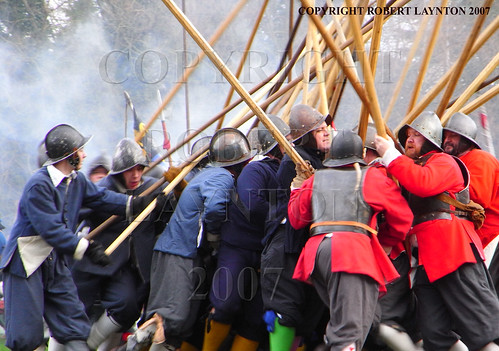
This re-enactment of an English Civil War battle takes place every January in Nantwich, Cheshire. members of the sealed Knot and other similar organisations dress up in Roundhead and Royalist clothing and act out the battle that took place in the 1640's. I am usually working on a Saturday, but this year, I happened to have the day off so I went to see what pictures I could get. If you have one of those cameras that takes multiple shots, you know, it automatically takes a few shots per second, then that mode is ideal for this kind of subject, because it is impossible to anticipate facial expressions and precise positions of people. There is a moderately strong element of chance and luck with regard to that, so this kind of shoot needs high volume or quantity, and you expect lots of rejects and failures. The other thing with this kind of historical re-enactment, is that you must really be aware of the background. A lampost, telegraph pole or car in the background tends to ruin the effect, so you have to choose your vantage point well and get in close using a telephoto lens, cropping out as much incongruent background as you can. being january in England, the light was poor, though we were lucky in that it was not raining and overly dull. Lucky also that the sun was not shining, because that would have restricted vantage points from which to take photos in a number of ways. The overcast day meant loss of colour brightness but softer shadows.

English Civil War re-enactment


English Civil War re-enactment, originally uploaded by foto-art.

The Sealed Knot at Nantwich, Cheshire.

Another shot of the Sealed Knot in action. This guy was spinning the blue flag around like a cheerleader, and I just kept taking shots hoping that one would come out O.K. I am quite pleased with this and a little modification would improve it a little more. I said in the previous photo that the photographer has to look at the backround as much as anything else. If you look below the blue flag on the right, you can see the yellow arms of a mechanical elevated platform, so to improve this picture, a little bit of pixel cloning using the branches of the trees to eliminate the yellow arms, would help to improve this shot.

Branches


Branches, originally uploaded by foto-art.

Tree branches. Another shot using black and white mode and a red filter to enhance contrast.

Sand dune fence


Sand dune fence, originally uploaded by foto-art.

Sand dune fence at Formby Point. This is an into the light or contre-jour shot and I do not think that I used any filters for this. This is about strong composition using strong shapes to create the effect. Notice also again the use of the rule of thirds, wuth the horizon about one third up and the main vertical posts being positioned also approximately at one third divisions.

Member of the Sealed Knot


Member of the Sealed Knot, originally uploaded by foto-art.

Puritan draws out his cash.

This shot does exactly the opposite of the previous Civil War re-enactment pictures. In the previous cases, I was concerned to remove any incongruent background objects such as pylons, telegraph poles, cars and so on, in order to keep an authentic period feel. Here I am using that very inconguence to create a slightly humourous picture, by putting into sharp juxtaposition the 17th and 21st centuries.

Sand dune grass


sand dune grass, originally uploaded by foto-art.

Sand dune grass at Formby Point, England. This shot is about texture as well as shape. Notice that the main tuft of grass is positioned one third in from the right. Its top is one third from the top and the main horizon in one third from the bottom. A red filter was used for this shot with the camera on black and white mode. This helps to give the grass that 'wispy' feel against a darker sky.

Sand dune fencing


sand dune fencing, originally uploaded by foto-art.

Sand dune fencing at Formby Point. This is a shot that worked equally well in black and white and colour, and therefore it relies almost entirely on strong composition.

Sand dune posts


sand dune posts, originally uploaded by foto-art.

Sand dune posts at Formby Point. This shot was taken in black and white mode using a red filter to increase contrast. Composition-Wise, the line of posts lead the eye in from the right to the larger posts an the area just to the left of them which is the main element of the picture. The grassy hill at the back leads the eye back towards the posts again.

Post 2


Post 2, originally uploaded by foto-art.

Fence post in the moorlands. I think that this was taken using a red filter, but I am not sure. The post is positioned one third in from the right and the horizon one third up from the bottom. The key thing here was a low viewpoint. I was either lying on the grass or squatting down and holding the camera low to get this shot. The low viewpoint means that the fence post is not lost against the background of grass, but rather, stands boldly against the sky.

Road signs


Road signs, originally uploaded by foto-art.

Road signs in the Peak District moorlands. It was the bold shape and colour of these signs contrasting with their natural surroundings that drew my eye to this picture. the road and the wall help to keep the eye in the picture instead of wandering off to one side or the other.

Hut


Hut, originally uploaded by foto-art.

Hut in the grounds of Little Moreton Hall, Cheshire, England. It was the semi abstract quality of these shapes that drew me to this image. A little bit of image rotation was done in photoshop to get the wooden planks square on. The window and the shadows from the cycle posts at the bottom are vital elements in this image and in fact the final print was cropped to avoid the brick wall and path at the bottom of this image.

Little Moreton Hall bw 1 - Polarising Filter tutorial


Little Moreton Hall bw 1, originally uploaded by foto-art.

Little Moreton Hall, South Cheshire, England. I took a number of shots of this hall both in colour and black and white. This shot was taken using a combination of red and polarising filters in black and white mode. I liked the way the sun was being reflected in the upper windows. The red filter serves to darken the sky and increase contrast creating a more dramatic effect. The polarising filter also darkens the sky by cutting out light travelling in a certain direction. The filter has to be rotated in front of the camera and at a certain angle, the sky darkens. However, the camera has to be pretty much at right angles to the sun for this to take effect, so the polarising filter is only useful for side lit subjects. however, the polarising filter works for both colour and black and white images. This filter can also be used to reduce the effects of haze.

Little Moreton Hall bw 2


Little Moreton Hall bw 2, originally uploaded by foto-art.

Little Moreton Hall, South Cheshire, England. Like its sister shot, this image too was taken in black and white mode using a combination of red and polarising filters to increase contrast and darken the sky.

Shutlingsloe - Print size and megapixel tutorial


Shutlingsloe, originally uploaded by foto-art.

Classic Peak District National Park scenery. I don't often do this kind of shot, but the light was just right here. The sun was quite low in the sky and so the texture and curves of the hills are picked out nicely. I increased the colour saturation slightly on Photoshop using the slider in Image/Adjust/HueSaturation menu. This kind of image is of a very conventional composition to me, with the farm and path leading the eye up the hill to the trees and summit. To be seen at its best, this kind of image needs a big enlargement and high quality, so the more megapixels the better. This would need to be a 16X20 inch print at the minimum to bring out the detail and to intimate the size of such a vista. The advantage of the more minimalist shots that are more common on this blog, is that they do not require such enlargements: the shapes and elements are bold and simple.

Fence


Fence, originally uploaded by foto-art.

Fence around Mow Cop castle folly. I just loved the strong dominant shape of this fence and the way it leads the eye into the picture. This works even better in high contrast black and white. A low viewpoint was chosen to help eliminate any distracting background, and a wide andle lens used (28mm) to increase the sense of perspective.

Dune tree


Dune tree, originally uploaded by foto-art.

Tree in the dunes at Formby Point, England. Definitely a competition entry for me. A combination of red and polaroid filters was used for this shot taken in black and white mode. I love the stong shape and texture of the tree against a minimalist plain background. The bit of tree trunk or stone lying on the ground in the distance on the right acts as a counterpoint to the tree, (and was there, honest, I did not place it there). Even the vapour trail of the plane in the sky adds to the shot.

Dune trees - Rotate image tutorial


Dune trees, originally uploaded by foto-art.

Trees near the beach at Formby Point. This little group of trees stood a little in isolation from surrounding trees and they stood out to me. I like the contrast between the softness of the grass and the hardness of the trees, and the complimentary colours of the grass against the sky. if I was going to do anything else to this, I would increase the colour saturation to make that contrast of colour more effective using Photoshop in Image/Adjust/HueSaturation. What is important in this shot is that the trees are vertical. The slope of the grass bank tends to make us compensate when taking a picture like this so that the trees end up at an angle. If this happens, it can be corrected in Photoshop using Image/Adjust/Rotate canvas/Arbitary. A value can be added here of say 2 or 3 degrees and the image can be rotated clockwise or counterclockwise to get the trees vertical. The image then has to cropped using the crop tool to restore a full image without angled backgound tone.

Stonewall 1


Stonewall 1, originally uploaded by foto-art.

Stone wall and fence post in the Peak District. A fairly typical black and white texture study. A red filter was used to increase contrast.

Stile


Stile, originally uploaded by foto-art.

Stile and fence in the Peak District National Park. Contre-Jour or into-the-light shots like this demand strong elements and good composition. The focal element here is the stile, which I have positioned just in front of the sun to help cut down too much flare and, using the rule of thirds, at about one third into the picture from the left. The remaining fence leads the eye down the picture to the gate, which stops the eye from moving out of the frame. The use of strong elements and composition like this is essential in good photography, whether contre-jour or not. It is where most amateurs fail. It is a good exercise to do some contre-jour work to learn to see such bold elements and learn how to frame them and compose them in the picture, because similar rules apply to othe types of image too.

Stonewall 2


Stonewall 2, originally uploaded by foto-art.

Stonewall, barbed wire and litter, Peak District. What struck me here was the contrast between the natural elements of stone and grass, and the polluting elements of wire and plastic.

Windswept tree 2


Windswept tree 2, originally uploaded by foto-art.

Windswept tree near Mow Cop, South Cheshire. A contre-Jour or into-the-light shot. Once again use of the rule of thirds is made. If I were to do anything more to this shot it would be to remove the branches on the expreme left of the picture by cropping or pixel cloning. If I chose cropping, I would be careful not to spoil the balance and arrangements of the elements, say by leaving the sun too far to the left. Cropping may demand some removal of the image all around to maintain this balance. The reflection of the sun on the lens at the right of the tree I am not sure about...I might try and remove it by pixel cloning and see if the picture looked better.

Windswept tree


Windswept tree, originally uploaded by foto-art.

Windswept tree near Mow Cop, South Cheshire. The tree and the fence post are the two elements in this composition. I moved around the tree to get the right distance between the post and the trunk of the tree and chose a low viewpoint using a wide andgle lens (28mm) to help remove any distracting background beyond the wall.

Signpost


Signpost, originally uploaded by foto-art.

Signpost at the Goyt Valley, near Buxton, Derbyshire. This image was taken in black and white mode using a combination of red and polarising filters. A low viewpoint was used to eliminate the distracting background from behind the signpost.

WALKERS


WALKERS, originally uploaded by foto-art.

Walkers on moorland near the Cat and Fiddle Inn, near Derbyshire, England. This was a spontaneous shot taking shortly after the picture of the posts a few images below. The moorland here is bleak: there are no trees or bushes, just a path along which these two people happened to be walking. I put the camera virtually on the ground for a very low viewpoint which made the walkers stand out against the horizon. I also used a primary red filter to increase the contrast, giving the shot more drama. In fact there is something slightly menacing about this shot: the people remain anonymous and vague in a very bleak landscape which is made even more bleak by the lack of colour.

STEPS


STEPS, originally uploaded by foto-art.

Steps leading to footpath for Three Shire Heads, near Buxton, Derbyshire. What appealed to me about this shot was the almost abstract and symmetrical quality of the steps against the very natural background of the hills in the Peak District National Park.

MOORLAND POSTS Black and white tutorial


POSTS, originally uploaded by foto-art.

Posts on Peak District moorland, near the Cat and Fiddle Inn, near Buxton, Derbyshire.

Well we had our first fine weather here in England last week: sharp crisp, frosty days with clear blue skies and bright sunshine, so it was my first real chance to get out this year and do a little photography. My first trip out was to the Peak District National Park near to the spa town of Buxton, walking near the Cat and Fiddle Inn which I understand is the highest pub in England. Of course, at this time of the year, there are no leaves on the trees: it will be a couple of months before spring arrives here, so the landscapes are still a little bare and bleak. last year I took a few sand dune photos and decided that I should really have taken some in black and white. Of course, you can convert colour images into black and white ones on photoshop, and that is explained in another post under the label 'colour to black and white'. However, you don't get quite the same result as taking the image in black and white on your camera. So for this image, I set the camera mode to black and white instead of colour. The advantage of this was that I could use contrast filters to make the image more dramatic. For this image I used a primary red filter (Wratten 25). This tends to darken the sky, making it more dramatic, and creates more contrast in the vegetation leading to a more dramatic picture. My new Ricoh camera has a 28mm equivalent wide angle lens, and this too gives a sense of space and drama, enabling me to get close to the fence posts and a low down vantage point, so that the posts stand out more dramatically against the sky, giving a stronger composition. notice again the rule of thirds, with the posts and horizon situated at approximately one third divisions in the frame.